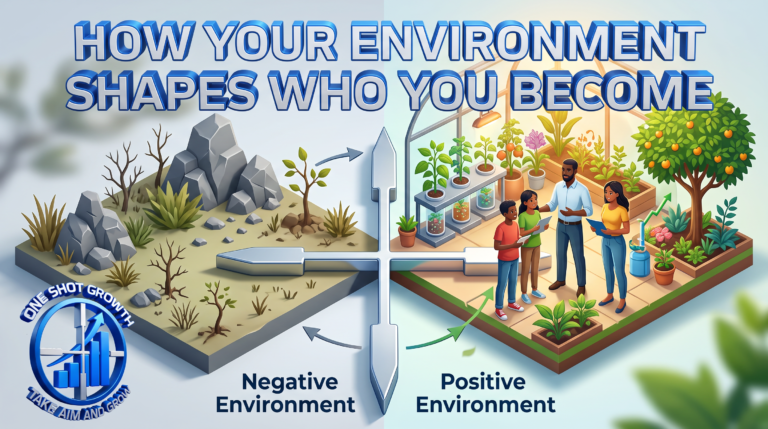
Your environment shapes who you become through repeated exposure, not through dramatic moments. The people you spend the most time with reset what feels normal, what feels like reasonable effort, and what you quietly tolerate in yourself. Over time, your baseline shifts toward the average of the rooms you are in most. Understanding this changes the question from how do I try harder to what am I returning to.
Environment works on identity through calibration. A room where honest conversation is the norm makes honest conversation feel natural. A room where extraordinary effort is standard makes extraordinary effort feel ordinary. This calibration runs constantly in the background, without a single dramatic decision, and it moves your baseline in the direction the room is pointing.
This is why willpower is a poor long-term strategy for becoming who you want to be. Willpower requires active effort to maintain. Environment works passively, between the moments of effort. Your baseline is what you drift toward when you stop trying, which is most of the time. The room that surrounds you while you are not trying is doing more of the identity work than most frameworks acknowledge.
Depth and breadth serve different purposes, and conflating them is one of the more common mistakes in how people think about community and network.
Breadth is where identity gets performed. A large network shows you a wide range of what is possible and creates surface-level social proof. These things have value. They do not compound identity the way depth does.
Depth is where identity gets built. Five people who have seen the real version of you, who have been in the room during the hard stretch, will shape who you become more than five hundred contacts who only see the highlight version. This is not about limiting your network. It is about understanding where the actual compounding happens.
The rooms that compound most are not always the ones with the most impressive conversations. They are the ones you keep returning to. Showing up when you have nothing polished to bring, when you are not at your best, when the contribution feels small: that is the input that separates a genuine community from a collection of occasional interactions. A small room you show up to consistently will shape you more than a prestigious one you attend quarterly.
Most people are in the rooms they inherited: family, early colleagues, whoever happened to be nearby during a formative stretch. Those rooms are not wrong. They are also not fixed, and treating them as the full scope of what is available is one of the more expensive defaults a person can carry into their working years.
Choosing rooms on purpose looks like identifying the version of you that you are building toward, finding communities where that version is already operating in some form, and returning to those rooms consistently enough that the calibration takes hold.
A room that compounds has three characteristics: it is honest enough that the real version of you is welcome, it is consistent enough that you return to it regularly, and it is pointed in a direction that aligns with where you are trying to go. The content of the conversations matters less than most people assume. The return is the input. The room does the rest.
If you are looking for a room built around both the personal and the professional side of growth running together, that is what One Shot Growth is building inside OSG AXIS. The link is in the description if you want to take a look.